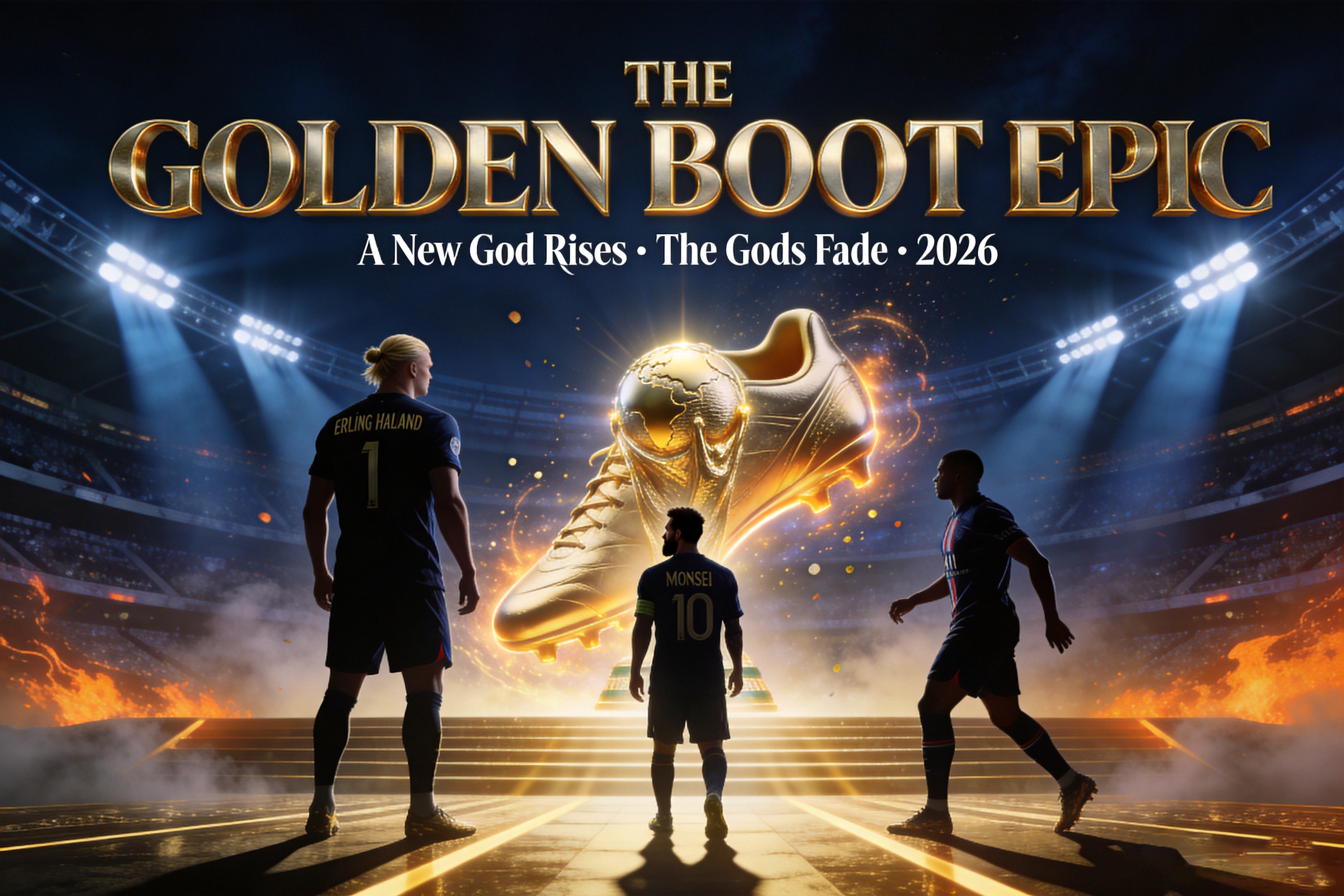
The Rise of a New King & The Twilight of Legends
Haaland topples Brazil while Messi and Mbappé continue writing football history—welcome to the greatest Golden Boot race the FIFA World Cup has ever witnessed.
⚽ A New Football Era
Discover how Haaland's dominance has transformed Norway into one of the tournament's biggest stories while redefining what a modern elite striker can achieve on football's biggest stage.
🏆 The Greatest Golden Boot Race
Compare the scoring consistency, tactical influence, expected goals, finishing efficiency, and leadership of Haaland, Messi, and Mbappé throughout the World Cup.
📈 Tactical Insights
Learn why high pressing, transition football, penalty efficiency, and clinical finishing have become the defining characteristics of the tournament's biggest contenders.
👕 World Cup Jersey Collections
Explore iconic national team kits inspired by unforgettable knockout performances and legendary players who continue to shape football history.
When One Generation Meets Another
Every World Cup eventually produces a tournament remembered not only for its champion but also for the moment football's balance of power changes forever. The 2026 edition is rapidly becoming that tournament. Veteran icons continue producing magical performances, while a new generation refuses to wait for permission to inherit the spotlight.
Erling Haaland's breathtaking display against Brazil was more than another knockout victory. It represented a symbolic shift in world football. One of the sport's traditional giants was eliminated by a striker entering the prime of his career, sending a clear message that the next football dynasty may already have arrived.
At the same time, Lionel Messi continues proving why greatness cannot be measured by age alone. Every touch, every assist, every decisive penalty reminds supporters that football legends never simply disappear—they redefine themselves. Meanwhile, Kylian Mbappé keeps chasing another Golden Boot with relentless speed, clinical finishing, and remarkable consistency, ensuring that every knockout match reshapes the race for individual glory.
It has become a battle between generations, philosophies, leadership styles, and footballing identities. Every goal changes history. Every penalty carries legacy. Every knockout match writes another unforgettable chapter.
Explore Popular National Team Collections
The knockout stage has inspired millions of supporters to follow their favorite teams more closely than ever. Whether you admire legendary champions or emerging contenders, these national team collections celebrate unforgettable moments from the 2026 World Cup.
The Rise of a New King: Erling Haaland's World Cup Has Changed Football
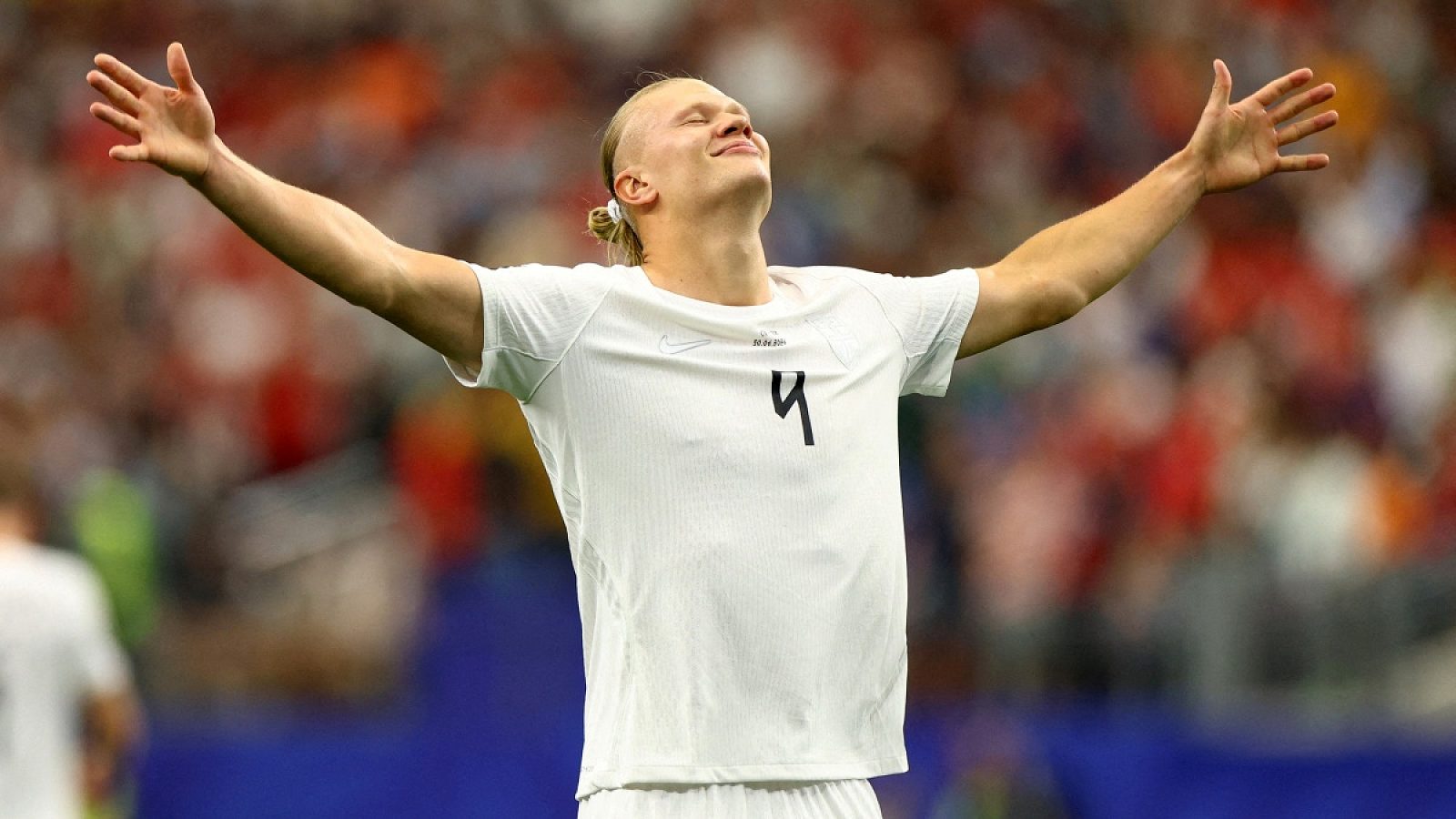
Every FIFA World Cup eventually produces one defining image that becomes part of football history. In 2026, that image is Erling Haaland standing tall after Norway eliminated Brazil, a result that instantly altered the balance of power in the tournament. For years, football supporters debated when the next global superstar would truly inherit the spotlight from an extraordinary generation led by Lionel Messi and Cristiano Ronaldo. This World Cup may have finally delivered the answer.
Haaland has not simply scored goals. He has become the tactical reference point around which Norway's entire attacking system revolves. His movement between defenders, relentless pressing, aerial dominance, explosive acceleration, and remarkable finishing have forced every opponent to redesign their defensive strategy. Few strikers in recent World Cup history have influenced matches with such consistency across every phase of play.
Norway's remarkable journey is not built on individual brilliance alone. It is a carefully balanced system combining disciplined defending, rapid transitions, intelligent midfield support, and one of the world's most complete centre-forwards leading the line.
Why Haaland Has Become the Tournament's Defining Player
⚽ Clinical Finishing
Haaland converts chances with remarkable efficiency, often requiring only one clear opportunity to change an entire match. His composure inside the penalty area continues separating Norway from its opponents.
🚀 Explosive Movement
Intelligent diagonal runs constantly stretch defensive lines, creating space for supporting midfielders while forcing centre-backs into uncomfortable one-versus-one situations.
💪 Physical Dominance
Strength, pace, balance, and aerial ability make him equally dangerous from crosses, counterattacks, set pieces, and direct build-up play.
🎯 Leadership
Beyond scoring goals, Haaland has inspired confidence throughout Norway's squad, transforming belief into disciplined performances during the knockout rounds.
World Cup 2026: Haaland's Journey So Far
How Modern Football Created the Perfect Stage for Haaland
Football has evolved dramatically over the past decade. Elite teams no longer rely solely on patient possession or individual creativity. Instead, modern tactical systems emphasize vertical progression, coordinated pressing, rapid transitions, and maximizing high-quality scoring opportunities. Few players are better suited to this environment than Erling Haaland.
Norway frequently defend in compact blocks before launching lightning-fast counterattacks. Once possession is recovered, Haaland immediately attacks the space behind defenders. His acceleration forces back lines to retreat, opening passing lanes for advancing midfielders while creating numerical advantages across the final third.
Against Brazil, this tactical approach repeatedly exposed defensive gaps. Rather than competing for prolonged possession, Norway focused on efficiency. Every transition carried genuine danger, proving that intelligent execution often outweighs territorial dominance in knockout football.
Explore National Team Collections
Inspired by the biggest performances of the tournament? Discover jerseys representing both legendary football nations and emerging contenders still chasing World Cup glory.
How Norway Shocked Brazil: The Night Football’s Hierarchy Shifted
Few results in modern World Cup history have sent shockwaves through the global football landscape like Norway’s elimination of Brazil in 2026. It was not just an upset on the scoreboard—it was a tactical dismantling of one of football’s most iconic national teams. Brazil arrived with possession dominance, creative midfield depth, and historical confidence. Yet what unfolded was a collision with a new tactical reality built on efficiency, transition speed, and ruthless finishing.
The match did not follow Brazil’s preferred rhythm. Instead of controlling tempo through long possession sequences, they were repeatedly forced into rushed decision-making. Norway’s compact defensive structure blocked central progression lanes, pushing Brazil wide and limiting high-value chances inside the box. Every recovery triggered an immediate vertical attack aimed directly at exploiting space behind the defensive line.
The decisive shift came when Brazil lost control of midfield transitions. Once Norway began winning second balls and accelerating counterattacks through Haaland’s movement, the match structure collapsed into a pattern Brazil could not recover from.
Tactical Breakdown: Why Brazil Couldn't Adapt
🧱 Compact Defensive Block
Norway maintained extremely tight vertical spacing between midfield and defense, eliminating Brazil’s central passing combinations and forcing low-percentage wide crosses.
⚡ Transition Supremacy
Every ball recovery immediately turned into a direct attacking phase. Norway’s first three passes consistently targeted forward zones rather than safe buildup play.
🎯 Haaland Positioning Effect
Even when not scoring, Haaland occupied both center-backs, creating constant uncertainty and pulling defensive lines out of shape.
📉 Brazil’s Structural Collapse
As the match progressed, Brazil’s midfield lost vertical compactness, allowing Norway to exploit half-spaces with increasing frequency.
Match Defining Moments
The game swung on a series of decisive transitions rather than prolonged spells of dominance. Each moment contributed to a growing psychological shift that ultimately favored Norway.
First Breakthrough: Norway’s early counterattack goal immediately forced Brazil into a reactive game state, disrupting their planned tempo control.
Midfield Collapse: A sequence of lost second balls around the 60th minute allowed Norway to dominate transitional phases completely.
Haaland’s Decisive Impact: Late attacking movements stretched Brazil’s defensive structure beyond recovery, creating decisive scoring opportunities.
What This Match Revealed About Modern Football
This result was not an accident. It highlighted a growing trend in elite football: structured efficiency is now capable of overcoming traditional possession dominance when executed with precision. Brazil’s philosophy remains rooted in creativity and control, but modern knockout football increasingly rewards teams that can transition faster and defend more compactly.
Norway’s performance demonstrated how elite strikers like Haaland can act as tactical gravity centers. Even without constant ball involvement, their presence shapes defensive behavior, creates space for teammates, and dictates match rhythm in ways that possession statistics cannot fully capture.
The Golden Boot War: Messi vs Mbappé vs Haaland
The 2026 FIFA World Cup has evolved into a historic individual rivalry as much as a national competition. Three defining figures—Lionel Messi, Kylian Mbappé, and Erling Haaland—have transformed the Golden Boot race into a global narrative that transcends tactics, formations, and even national expectations. Every match now feels like a chapter in a larger story about legacy, evolution, and football immortality.
Unlike previous tournaments where one or two players dominated the scoring charts, this edition features three radically different footballing identities competing at the same statistical peak. Messi represents creative intelligence and emotional leadership, Mbappé embodies explosive acceleration and clinical finishing in transition, while Haaland defines pure penalty-box efficiency and physical dominance.
This is no longer just a scoring contest. It is a comparison of football philosophies—vision versus speed versus power—all converging in one tournament.
Three Players, Three Football Universes
🧠 Lionel Messi
Messi continues to dictate matches through spatial awareness, disguised passing, and penalty composure. Even at this stage of his career, his influence remains tactical rather than purely statistical.
⚡ Kylian Mbappé
Mbappé remains the most dangerous player in open space. His ability to turn defensive transitions into scoring opportunities defines France’s attacking identity in knockout matches.
💥 Erling Haaland
Haaland dominates inside the box with unmatched efficiency. His conversion rate under pressure and aerial strength make him the most consistent finisher in the tournament.
📊 Statistical Parity
All three players remain within striking distance of the Golden Boot lead, ensuring that every knockout match can instantly redefine the standings.
How Each Superstar Changes a Match
What separates these three icons is not only their goal output but how they influence the structure of a match. Messi often drops deep to create overloads, Mbappé stays on the shoulder of defenders waiting for explosive transitions, and Haaland anchors the entire attacking system as a fixed reference point.
Against elite defensive teams, these differences become decisive. Messi forces compact midfield reshaping, Mbappé punishes high defensive lines, and Haaland capitalizes on every half-chance inside the penalty area. Together, they represent the full spectrum of modern attacking football.
Momentum Shifts in the Golden Boot Race
Messi’s Influence Phase: Matches often slow down into controlled possession systems where Messi dictates tempo and creates decisive passes in tight spaces.
Mbappé’s Transition Explosions: Sudden counterattacks instantly reshape scorelines, especially when France faces higher defensive lines.
Haaland’s Finishing Streaks: When Norway enters attacking rhythm, even half-chances become statistically decisive moments.
Why This Golden Boot Race Is Historically Unique
In previous World Cups, Golden Boot winners often emerged from dominant teams with consistent attacking flow. However, the 2026 edition features three players from structurally different systems, each maximizing different aspects of modern football evolution.
This creates a rare statistical equilibrium where no single playing style dominates. Instead, success depends on tactical adaptability, knockout-stage efficiency, and the ability to perform under extreme pressure environments.
Golden Boot Stats Dashboard: Fine Margins Define Greatness
At this stage of the 2026 FIFA World Cup, the Golden Boot race between Messi, Mbappé, and Haaland is no longer separated by style—it is separated by the finest statistical margins. Goals, expected goals, penalty conversion rates, and knockout-stage efficiency are now the key indicators shaping football’s most prestigious individual award.
Each player thrives in a different statistical ecosystem. Messi excels in chance creation and decisive involvement, Mbappé dominates high-speed transitions, and Haaland maintains unmatched finishing efficiency inside the penalty area. Together, they form a rare statistical triangle that defines modern football excellence.
Performance Comparison Overview
⚽ Lionel Messi
High assist involvement, elite chance creation in tight spaces, and exceptional penalty calmness under knockout pressure define his continued influence.
⚡ Kylian Mbappé
Maximum speed in transition phases with elite conversion on counterattacks, making him the most dangerous player in open-field situations.
💥 Erling Haaland
Highest shot-to-goal efficiency inside the box, dominant aerial win rate, and elite positioning metrics across all knockout matches.
📊 Key Insight
The Golden Boot race is effectively decided by conversion efficiency rather than total chances created, emphasizing clinical finishing over volume.
The Penalty Era: Where Legends Are Separated
Modern knockout football increasingly shifts decisive moments into penalty situations. The 2026 World Cup has amplified this trend, with multiple high-stakes matches being decided either directly from the spot or through penalty shootouts. In this environment, composure becomes as valuable as speed or creativity.
Messi: Uses controlled rhythm and psychological calmness to outthink goalkeepers during penalty situations.
Mbappé: Relies on power and unpredictability, often committing goalkeepers early with explosive finishing.
Haaland: Executes penalties with mechanical precision, prioritizing placement and consistency over deception.
Why Efficiency Beats Volume in Modern World Cups
One of the most important evolutions in football analytics is the shift from volume-based attacking metrics to efficiency-based outcomes. Possession dominance no longer guarantees victory, and shot volume does not necessarily correlate with success.
Instead, teams and players who maximize high-quality chances—especially inside transition phases or set-piece situations—are increasingly outperforming traditionally dominant sides. This explains why Haaland’s presence, Mbappé’s counterattacking speed, and Messi’s creative precision all remain equally dangerous in very different contexts.
Momentum Profiles: Three Different Ways to Dominate Matches
🧠 Messi Momentum
Builds gradually through possession control, increasing influence as defensive structures fatigue over time.
⚡ Mbappé Momentum
Appears instantly through explosive counterattacks that change scorelines in seconds.
💥 Haaland Momentum
Surges in bursts where multiple chances are converted in rapid succession inside the penalty box.
📉 Tactical Conclusion
Momentum is no longer linear—it is situational, depending on match phase, defensive structure, and transition frequency.
The Global Impact of This Rivalry
Beyond statistics, this Golden Boot race has become a cultural phenomenon. Fans across continents are not only tracking goals but also debating styles, legacy, and the evolution of football identity itself.
The Messi-Mbappé-Haaland triangle represents a rare convergence where three different football eras overlap in real time, creating a unique narrative that will define how future generations interpret this tournament.
The Penalty Symphony: Where the World Cup Becomes Pure Drama
In the 2026 FIFA World Cup, knockout football has evolved into a stage where matches are no longer decided only by open play. Instead, penalties—both during regular time and in shootouts—have become the emotional and tactical climax of entire tournaments. This is where Messi, Mbappé, and Haaland each reveal completely different versions of greatness.
The penalty moment is no longer just a technical execution. It is psychology, legacy pressure, crowd noise, and historical weight condensed into a single strike. Every step toward the ball carries the expectation of an entire nation.
Three Penalty Philosophies, Three Different Worlds
🧠 Messi: Controlled Silence
Messi approaches penalties with minimal movement, reading the goalkeeper's timing rather than overpowering the shot. His success comes from anticipation and psychological control.
⚡ Mbappé: Explosive Decision
Mbappé commits late and strikes with explosive force, often forcing goalkeepers into premature dives before the ball is fully released.
💥 Haaland: Mechanical Precision
Haaland treats penalties as repeatable execution patterns—low variance, high accuracy, and minimal emotional deviation under pressure.
📊 Key Insight
In modern knockout football, penalty success is less about creativity and more about psychological stability under extreme pressure.
How Knockout Football Changed in 2026
The modern World Cup is no longer dominated by slow build-up systems or purely possession-based dominance. Instead, teams now prioritize vertical transitions, compact defensive blocks, and efficiency in limited-space environments.
This evolution has elevated players like Haaland, Mbappé, and Messi—each representing a different solution to the same tactical problem: how to break elite defensive structures under knockout pressure.
Possession does not win knockout matches. Precision, timing, and conversion do.
Defining Moments That Shape a World Cup
Every legendary tournament is remembered through a handful of irreversible moments. In 2026, these moments are defined by penalty decisions, counterattack finishes, and individual brilliance under maximum pressure.
Moment 1: A single counterattack that shifts Brazil from dominance to elimination.
Moment 2: A late-game penalty that restores balance to a match thought already decided.
Moment 3: A decisive knockout strike that instantly reshapes Golden Boot rankings.
The Tournament Has Become a Three-Layer Story
The 2026 World Cup is no longer a single narrative. It operates on three parallel layers:
Team Layer: Tactical systems, defensive structures, and national identity.
Player Layer: Messi, Mbappé, and Haaland competing for individual legacy.
Moment Layer: Penalties, transitions, and single actions that decide entire futures.
Frequently Asked Questions: World Cup 2026 Golden Boot & Knockout Drama
The 2026 FIFA World Cup has generated intense global discussion around three central figures—Messi, Mbappé, and Haaland—while also reshaping how fans interpret knockout football, penalty pressure, and tactical evolution. Below are the most searched questions driving global attention across AI search engines and Google Discover.
Q&A: Key Questions from Fans Worldwide
Q1: Who is leading the Golden Boot race?
The race remains extremely tight, with Messi, Mbappé, and Haaland separated by only a few decisive goals influenced heavily by knockout-stage performance.
Q2: Why did Brazil lose to Norway?
Brazil struggled against Norway’s compact defensive structure and rapid transition system, which allowed Haaland to exploit space efficiently.
Q3: Is this Messi’s last World Cup run?
This tournament is widely viewed as one of the final major international chapters in Messi’s legendary career.
Q4: What makes Mbappé so dangerous?
His unmatched acceleration in transition phases allows him to convert defensive moments into scoring opportunities in seconds.
Related National Teams Dominating the Tournament
Related Players to Watch
Lionel Messi
The creative heartbeat of Argentina, still shaping matches with vision and leadership under pressure.
Kylian Mbappé
France’s explosive forward redefining transition football with elite speed and finishing precision.
Erling Haaland
Norway’s goal machine dominating penalty-box efficiency and knockout-stage scoring impact.
Jude Bellingham
England’s midfield leader combining physicality, intelligence, and attacking contribution.
The Future After the Golden Boot War
As the 2026 FIFA World Cup moves toward its decisive stages, the rivalry between Messi, Mbappé, and Haaland is already shaping how future generations will understand elite football performance. This is no longer just a tournament—it is a reference point for how modern attacking football is measured, analyzed, and remembered.
The tactical identity of world football is shifting rapidly. Teams are moving away from long possession cycles and toward vertical efficiency, transition dominance, and high-impact finishing moments. The influence of this World Cup will extend far beyond the final whistle, reshaping scouting, analytics, and even youth development philosophies.
How This Tournament Will Change Football Forever
📊 Tactical Revolution
Efficiency-based attacking systems are replacing traditional possession dominance across elite clubs and national teams.
⚽ Striker Evolution
The Haaland profile signals a return of pure finishing specialists within highly structured tactical environments.
⚡ Transition Era
Mbappé’s style reinforces the importance of speed-based attacking phases in modern knockout competitions.
🧠 Creative Legacy
Messi’s influence highlights that creativity and intelligence remain irreplaceable in high-pressure scenarios.
Final Analysis: Why This World Cup Is Historic
The 2026 edition will be remembered not only for its champions but for the rare convergence of three generational forces at their peak. Messi represents the final expression of classical playmaking intelligence. Mbappé embodies the evolution of speed-driven modern football. Haaland defines the purest form of penalty-box efficiency the game has seen in decades.
Together, they create a triangular narrative that balances creativity, explosiveness, and precision. This balance is what makes the Golden Boot race uniquely unpredictable and historically significant.
Football greatness is no longer defined by a single dominant style. It is defined by the coexistence of multiple peak philosophies competing in the same competitive environment.
FAQ: Understanding the 2026 Golden Boot & Knockout Story
Why is Haaland so effective in knockout matches?
His positioning, physical strength, and finishing efficiency make him especially dangerous in low-chance, high-pressure environments.
What makes Mbappé different from other forwards?
His acceleration in transition phases allows him to consistently exploit defensive imbalance within seconds.
How does Messi still influence games?
Through spatial control, passing intelligence, and penalty composure in decisive moments.
Who is most likely to win the Golden Boot?
The outcome remains open due to the extremely close statistical competition and knockout-stage variability.
Relive the World Cup Through Legendary Jerseys
Celebrate the defining tournament of a generation by exploring national team collections inspired by football’s greatest modern icons.